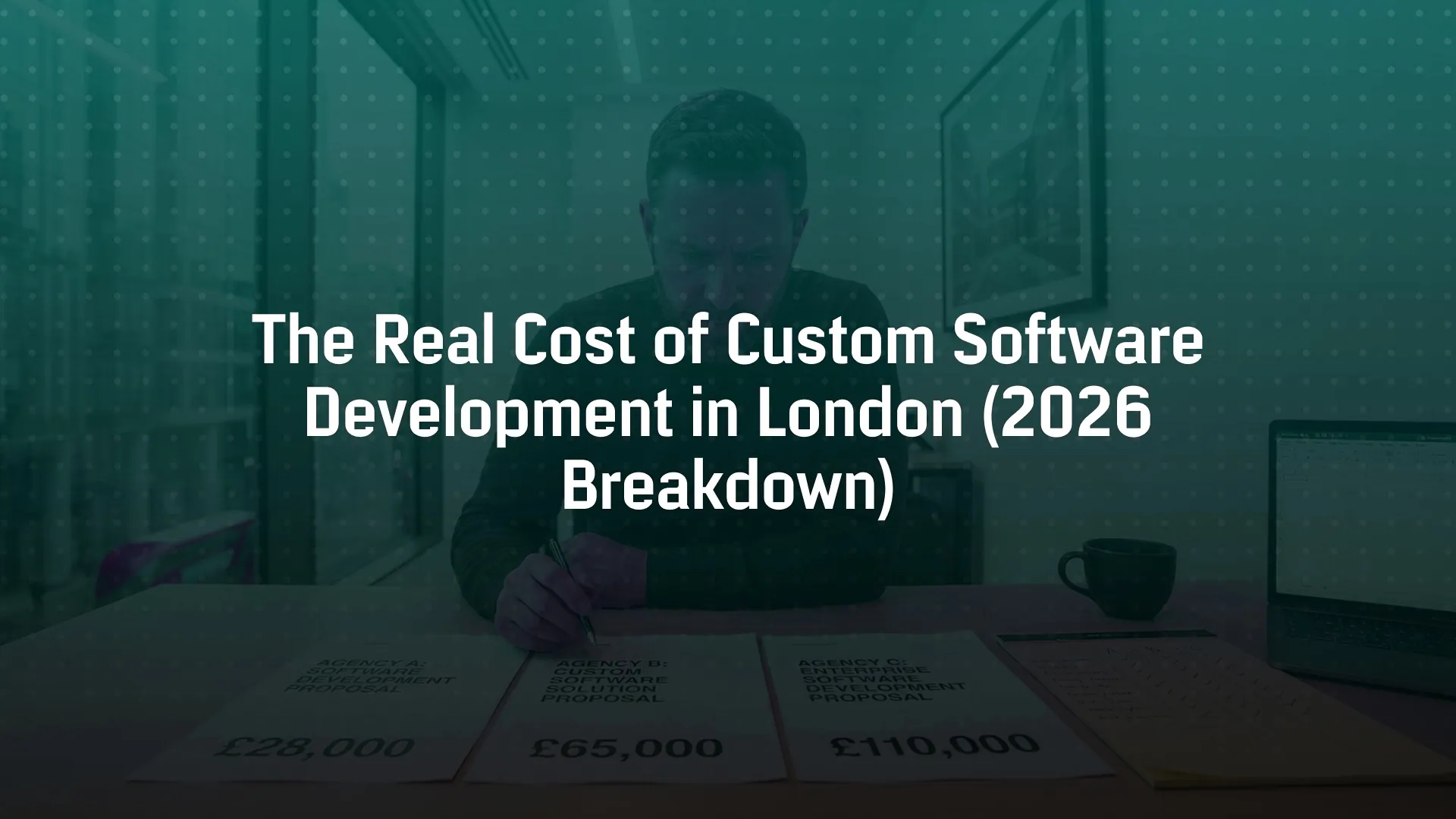
You asked three agencies for a quote. One came back at £28,000. One came back at £65,000. One came back at £110,000. All three read the same brief. All three are building the same thing. And you have absolutely no framework for understanding why the numbers are £82,000 apart or which of them is actually right.
This is where most London businesses stall on the custom software decision. Not because they can’t afford it. Because they can’t evaluate it. When you don’t understand what drives the cost of a custom software project, every quote looks either like an overcharge or a warning sign, and you end up either overpaying for something you didn’t need or underpaying for something that won’t work.
The London software development market in 2026 is more varied in pricing than it has ever been. Developer day rates in London range from £350 for junior contractors to over £1,200 for senior architects on complex compliance-sensitive projects. According to a 2025 Stack Overflow developer survey, the average software developer salary in London is £72,000, which translates to a loaded daily cost of approximately £550 before agency margin. That number gives you a baseline. This guide gives you the framework to understand everything above it.
By the end of this article, you will know what drives cost in a custom software project, what the realistic price ranges are for different project types in London in 2026, where budget disappears without producing value, and how to evaluate a quote with enough precision to know whether you’re looking at a fair price or a mismatch between what was understood and what was quoted.
Why Two Agencies Quote £80,000 Apart for the Same Project
The gap between quotes for the same software brief is almost never a reflection of one agency being dishonest. It is a reflection of four agencies understanding four different projects from the same document.
Software briefs written by non-technical buyers are almost always underspecified. They describe what the software should do at a surface level: a user management system, a reporting dashboard, a client portal. What they rarely describe in sufficient detail is the data structure beneath those features, the integration requirements those features depend on, the user role hierarchy that governs access, the compliance constraints that shape the architecture, and the performance requirements that determine whether the system needs to be engineered for scale from day one or can start simple and grow.
When agencies interpret an underspecified brief, they fill the gaps with assumptions. A junior team assumes the simplest possible interpretation and quotes accordingly. A senior team with domain experience identifies the complexity that the brief doesn’t state and prices for it. A third team quotes a low number to win the project and plans to recover margin through change orders once work begins. All three quotes reflect genuine assessments. None of them reflect the same project.
The best software agencies in London 2026 address this problem directly: they run a paid discovery phase before quoting, produce a detailed technical specification, and price against that specification rather than against the brief. This approach produces more accurate quotes, fewer change orders, and better outcomes. It also costs money. Expect to pay between £2,500 and £8,000 for a serious discovery phase on a mid-complexity project. That cost is not overhead. It is insurance against a £30,000 scope disagreement six months into delivery.
The Six Cost Drivers in Every Custom Software Project
Understanding what drives cost is more useful than knowing any specific price range, because cost drivers are consistent across projects even when total prices vary significantly.
Team seniority and composition. The single largest variable in custom software cost is who builds it. A team of three mid-level developers costs roughly £1,800 per day in London. A team of two senior engineers, a lead architect, and a QA specialist costs roughly £3,200 per day. The senior team typically delivers faster, with fewer bugs, and with architecture that requires less rework at scale. The cost difference over a twelve-week project is approximately £67,200. The value difference, in reduced QA cycles, fewer post-launch issues, and longer architecture life, frequently exceeds that figure over a two-year horizon.
Discovery and architecture depth. Projects that invest properly in discovery and architecture typically spend 15% to 20% of total project budget on these phases before a single feature is built. This feels like overhead to buyers who want to see visible progress quickly. It is not overhead. It is the phase that determines whether the remaining 80% of budget produces the right product. Skipping or compressing discovery consistently produces cost overruns, scope disputes, and rebuilt features. The savings from compressing discovery are almost always illusory.
Integration complexity. Every integration with an external system, whether a payment gateway, a CRM, a third-party API, or an enterprise database, adds scope, testing cycles, and maintenance risk to a project. A platform with no integrations is significantly simpler than a functionally identical platform that must connect to five external systems. Integration complexity is the most underestimated cost driver in almost every custom software brief. Buyers describe their integrations in one sentence. The engineering reality behind that sentence is often worth £5,000 to £25,000 per integration depending on the API quality and documentation of the target system.
Compliance and security requirements. Projects in healthcare, financial services, legal, and public sector contexts carry compliance requirements that affect architecture, data handling, audit trail design, and testing scope in ways that non-regulated projects don’t. GDPR data residency requirements, FCA operational resilience standards, NHS data security obligations: each of these adds engineering scope that doesn’t appear in a functional brief but must appear in the cost. A financial services platform without FCA-compliant architecture is not a cheaper financial services platform. It is a platform that will fail regulatory review.
UI/UX design scope. The difference between a functional interface and a well-designed interface is significant in both cost and outcome. Basic UI implementation adds approximately 20% to 25% to a project’s development cost. A full UX research and design process, including user testing, prototype iteration, and design system development, adds 35% to 50% depending on the number of user journeys and the complexity of the interaction design. For consumer-facing products where interface quality directly affects conversion and retention, that investment produces measurable commercial returns. For internal tools used by trained staff, it frequently doesn’t.
Post-launch support and iteration scope. The cost of building a custom software product is not the total cost of owning it. Ongoing maintenance, performance monitoring, security patching, and feature iteration represent a recurring annual cost that typically runs between 15% and 25% of the original build cost. A £60,000 build carries an ongoing annual cost of £9,000 to £15,000. This cost is not optional, it is the price of keeping the system secure, performant, and aligned with evolving business requirements. Budget for it from the start rather than treating it as a future problem.
2026 Price Ranges by Project Type in London
These ranges reflect the London market in 2026, based on current developer rates, agency margins, and project complexity distributions. They are ranges, not guarantees: every project’s actual cost depends on the specific drivers described above.
Simple internal tools and workflow automation: £12,000 to £28,000. Single-function applications, basic workflow automation, simple reporting dashboards, internal admin tools with limited user roles and no external integrations. Appropriate for SMEs solving a specific, contained operational problem. Timeline: six to ten weeks.
Customer-facing web applications: £30,000 to £75,000. Multi-user platforms, client portals, booking systems, subscription platforms. Includes user authentication, role-based access, basic integrations with payment or communication systems, and a designed interface rather than a functional one. Timeline: ten to eighteen weeks.
E-commerce platforms with custom logic: £40,000 to £90,000. Custom e-commerce builds that go beyond standard Shopify or WooCommerce configuration: complex product configurators, multi-vendor marketplaces, wholesale pricing logic, advanced inventory management, bespoke checkout flows. The London ecommerce development agencies that specialise in custom builds at this level typically price on a project basis rather than a day rate, with milestones tied to specific functional deliverables. Timeline: twelve to twenty weeks.
CRM and operational platforms: £45,000 to £120,000. Custom CRM systems, field service management platforms, case management tools, workflow engines. These projects typically involve complex data models, multiple user roles with differentiated permissions, significant integration scope, and reporting requirements that off-the-shelf CRM platforms can’t meet. The investment in custom CRM development London is justified when the workflow the CRM must support is specific enough that a configured Salesforce or HubSpot instance requires more customisation than the custom build would cost. Timeline: sixteen to twenty-eight weeks.
Mobile applications: £35,000 to £85,000. Native iOS, native Android, or cross-platform Flutter applications. The range reflects the difference between a simple content or utility app and a complex transactional application with offline capability, device integration, and a backend API. Cross-platform development using Flutter typically costs 30% to 40% less than building separate native apps while achieving 85% to 90% of the performance of a native build. Timeline: twelve to twenty weeks.
Enterprise platforms with compliance requirements: £80,000 to £250,000+. Multi-system enterprise platforms, healthcare data management systems, financial services applications with regulatory architecture, multi-tenant SaaS products, and platforms requiring SOC 2, ISO 27001, or NHS DSP Toolkit compliance. These projects involve architecture review cycles, penetration testing, compliance documentation, and engineering standards that add scope regardless of functional complexity. Timeline: twenty to fifty-two weeks.
Where Budget Disappears Without Producing Value
Understanding where cost should go is only half the picture. The other half is understanding where cost disappears without producing proportionate value, because in custom software projects, budget leakage is consistent enough to be predictable.
Scope additions after architecture is locked represent the most expensive category of budget leakage in custom software. A feature added in sprint one costs £3,000 to implement. The same feature added in sprint eight, after the data model is built, the API structure is defined, and the UI framework is established, costs £9,000 to £18,000 because it requires changes to existing architecture rather than additions to it. The feature didn’t get more complex. The cost of changing a locked system did.
Evaluate every scope addition against the architecture impact, not just the feature complexity. The best software agencies in London 2026 apply a formal scope change protocol that requires architecture impact assessment before any new feature is approved mid-project. Agencies that process scope changes informally are agencies that will deliver change orders at the end of a sprint rather than impact assessments at the start of one.
Underinvestment in QA is the second major source of budget leakage. Projects that allocate less than 15% of build budget to quality assurance consistently pay more in bug-fix cycles post-launch than the QA saving was worth. A £60,000 project that allocates £4,000 to QA rather than £9,000 typically generates £12,000 to £20,000 in post-launch bug resolution costs within the first six months. That arithmetic is not a coincidence. It is what happens when defects reach production that testing would have caught in development.
Vague acceptance criteria is the third. When a feature is described as “complete” without a specific, measurable definition of what complete means, the agency and the client inevitably disagree on whether it’s finished. Those disagreements cost time, money, and the relationship. Define acceptance criteria for every deliverable before the sprint begins rather than at the point of review.
The Hidden Costs Buyers Never Budget For
Several cost categories are real, consistent, and almost universally absent from buyer budgets for custom software projects.
Stakeholder time. Custom software projects require significant input from the people who will use and manage the system. Discovery workshops, sprint reviews, user acceptance testing, and feedback cycles consume internal time that has a real cost even when it doesn’t appear on an invoice. Budget for thirty to sixty hours of internal stakeholder time per month on a mid-complexity project, and consider the opportunity cost of those hours.
Data migration. If the new system replaces an existing platform, migrating the data from the old system to the new one is a project in its own right. Depending on data volume, structure, and quality, migration can cost between £3,000 and £25,000 and requires dedicated engineering time that doesn’t come from the build budget. Plan for it separately.
Training and change management. A new system that your team doesn’t know how to use delivers no value. Training cost for a mid-size team on a new operational platform typically runs £2,000 to £8,000 depending on complexity and team size. For platforms that significantly change how people work, change management cost can exceed training cost.
Infrastructure and hosting. Custom software requires hosting, and hosting for production-grade applications costs real money. AWS, Google Cloud, or Azure hosting for a standard web application with appropriate redundancy, backups, and monitoring typically costs £200 to £800 per month depending on traffic volume and data requirements. Budget this as a recurring operational cost from day one rather than an afterthought at launch.
How to Evaluate a Quote Without a Technical Background
You don’t need a technical background to evaluate a software development quote well. You need the right questions and the discipline to press for specific answers rather than accepting vague ones.
Ask the agency to break the quote into phases rather than presenting a single total. Discovery, architecture, build, QA, and launch should be separately identified with their own costs and timelines. If an agency can’t break a project into phases, they haven’t planned the project.
Ask what the quote assumes about integrations. Every integration should be named, with an individual cost and a description of what happens if the target API is more complex than anticipated. Integration overruns are the most common source of mid-project budget surprises. Naming them upfront converts surprises into managed risks.
Ask what is explicitly out of scope. The most revealing section of any quote is what it doesn’t include. Post-launch support, data migration, training, and infrastructure are frequently absent from initial quotes. Their absence doesn’t mean they’re free. It means the conversation about their cost is deferred to a less convenient moment.
Demand numbers from case studies rather than narrative outcomes. Ask: what was the original quoted cost, what was the final delivered cost, and what drove the difference? Any agency that has delivered projects honestly can answer that question. Any agency that gives you a version of “we always deliver on budget” is not giving you information.
FAQ: Custom Software Development Costs in London (2026)
What is the average cost of custom software development in London in 2026?
Project costs range from £12,000 for simple internal tools to £250,000 or more for enterprise platforms with compliance requirements. Mid-complexity projects, customer-facing web applications with multiple integrations and a designed interface, typically range from £40,000 to £90,000. The most useful number is not the average but the realistic range for your specific project type, factoring in team seniority, integration complexity, compliance requirements, and UI scope.
Why do custom software quotes vary so much between agencies?
Quotes vary because agencies make different assumptions about what an underspecified brief requires. A brief that describes surface functionality without detailing data architecture, integration requirements, compliance constraints, or performance targets will generate quotes that reflect different interpretations rather than different prices for the same project. Running a paid discovery phase before requesting quotes is the most reliable way to get comparable numbers from multiple agencies.
How much should I budget for post-launch maintenance?
Budget 15% to 25% of the original build cost per year for ongoing maintenance, security updates, performance monitoring, and minor feature iteration. A £60,000 build requires £9,000 to £15,000 per year in maintenance budget to remain secure, performant, and aligned with evolving requirements. This is not optional overhead. It is the cost of owning infrastructure rather than renting it.
What is a discovery phase and why does it cost money?
A discovery phase is a structured process of mapping requirements, defining architecture, and producing a technical specification before any build work begins. It typically costs £2,500 to £8,000 for a mid-complexity project and takes two to four weeks. It reduces change order risk, improves quote accuracy, and ensures the build phase produces the right product rather than the stated one. Discovery is the most cost-effective investment in any custom software project.
Is it cheaper to hire developers directly rather than using an agency?
Direct hiring is cheaper on a day-rate basis but carries hidden costs that agencies absorb: recruitment time, employer NI and benefits, management overhead, knowledge transfer risk, and the gap when a developer leaves mid-project. For projects shorter than six months, agency engagement is almost always more cost-effective than direct hiring when total cost is honestly calculated. For long-term platform teams, direct hiring at senior level combined with agency support for specialised work often produces the best cost-quality balance.
How do I know if a quote is fair?
A fair quote is a quote that reflects a clear understanding of your requirements, breaks the project into specific phases with individual costs, names integration assumptions explicitly, defines what is out of scope, and includes post-launch support structure. A quote that presents a single number against a surface-level brief is not a fair quote. It is a number that will change once the project begins.
The Number That Actually Matters
The sticker price of a custom software project is not the number that determines whether the investment was right. The number that matters is the value the software generates relative to what it cost to build and maintain over a relevant time horizon.
A £90,000 platform that automates a process costing £60,000 per year in staff time pays back in eighteen months and delivers £60,000 in annual savings from year two onward. A £25,000 platform built cheaply, without proper discovery, that requires a £40,000 rebuild twelve months after launch, costs £65,000 and delivers nothing. The cheaper project was not the cheaper decision.
Evaluate cost against value. Build for the outcome rather than the budget. Choose partners who price for delivery rather than for the contract.
If you want a straightforward, itemised cost assessment for your software project, book a free 30-minute discovery call with Empyreal Infotech. No pitch deck. No pressure. Just a direct conversation about what your project actually costs and what drives those numbers.
Spend on what earns. Cut what doesn’t.