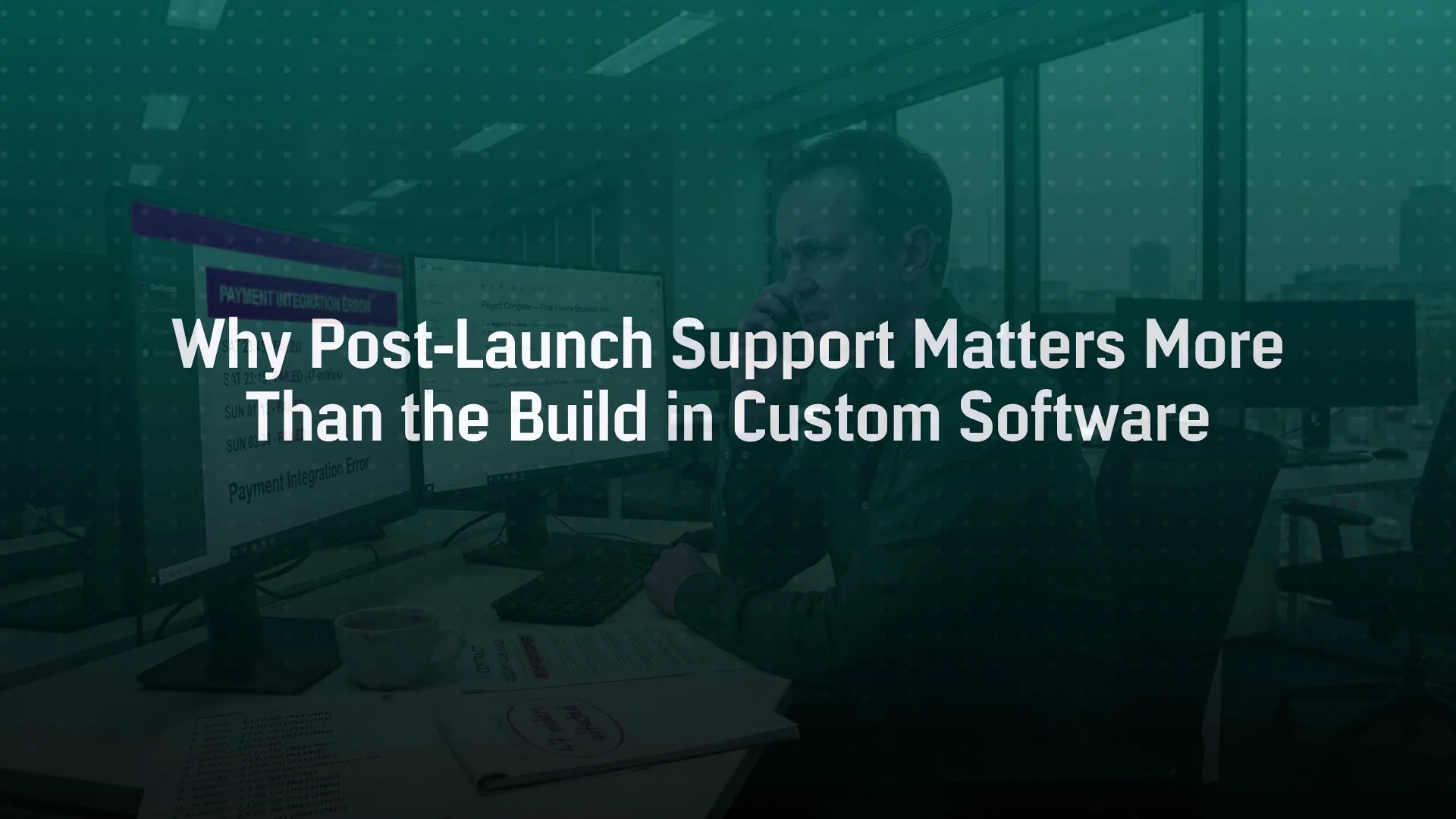
The software launched on time. The team celebrated. The agency sent the final invoice and closed the project. Three weeks later, a bug in the payment integration caused forty-seven transactions to fail silently over a weekend. By Monday morning, forty-seven customers had not received their orders, forty-seven refunds were being manually processed, and the agency that built the platform was no longer contractually obligated to respond within any particular timeframe.
This is the moment most custom software buyers discover that the build was never the finish line. It was the starting line.
Deployment is not completion. It is the point at which real users interact with real data under real operational conditions for the first time. Every assumption made during discovery, every edge case that testing didn’t surface, every integration behaviour that differed from the sandbox environment: all of it becomes visible after launch rather than before it. According to a 2025 Forrester Research study, 62% of critical software defects in custom applications are discovered within the first ninety days of live operation rather than during QA cycles. That figure has held steady for years because no testing environment fully replicates the conditions of real production use at scale.
The custom software development companies in London that understand this treat post-launch support not as an optional add-on but as the phase where the investment either compounds or erodes. The build determines what you have. Post-launch support determines what it becomes.
Why the Industry Gets Post-Launch Support Wrong
The standard model for post-launch support in the UK software development market is a warranty period: thirty, sixty, or ninety days during which the agency is contractually obligated to fix defects identified as originating in the original build. After that period, support moves to a separate commercial arrangement, typically a retainer or time-and-materials engagement, negotiated after the relationship has already been tested by the stresses of go-live.
This model is wrong in its structure. Not because warranty periods are unreasonable, but because they locate the commercial negotiation about post-launch commitment at exactly the wrong moment in the relationship. When you negotiate post-launch support after go-live, you negotiate from a position of dependency. The agency knows you can’t migrate easily. The price reflects that.
The best post-launch support arrangements are negotiated before a single line of code is written rather than after the project closes. They define: what constitutes a critical defect versus a minor one, the response time commitment for each severity level, how feature requests are triaged and prioritised, what the monthly monitoring and reporting cadence looks like, and who on the agency team retains institutional knowledge of the system after the build team moves to other projects. Partners who can’t answer those questions before the project starts are partners who haven’t thought seriously about what they’ll deliver after it ends.
Not a warranty. A partnership model. Those are structurally different arrangements.
What Actually Happens to Custom Software After Launch
The trajectory of a custom software application after launch follows a predictable pattern when post-launch support is inadequate. Understanding that pattern makes the case for investing in support more compelling than any abstract argument about best practice.
In the first thirty days, the system performs largely as designed. The team is familiar with it, edge cases haven’t accumulated, and the integration points are behaving consistently. Confidence is high. This is the period in which under-supported systems generate the most dangerous false signal: the sense that the build was so good that ongoing support is barely necessary.
Between thirty and ninety days, real usage patterns begin to diverge from the assumptions that shaped the build. Users find workflows the discovery process didn’t anticipate. Data volumes reach levels that expose performance constraints. Integration dependencies update on the vendor’s schedule rather than the client’s, and API changes that weren’t in the original build’s testing scope begin to create friction. The first significant defects surface. If a support structure is in place, they are caught, triaged, and resolved within days. If it isn’t, they accumulate.
Between ninety days and twelve months, the system either compounds in value or begins to degrade. Systems with active post-launch support receive regular security patches, performance optimisations, and small feature iterations that keep the system aligned with evolving business requirements. Systems without active support accumulate technical debt: unpatched vulnerabilities, performance degradation under growing data volumes, and an increasing gap between what the system does and what the business needs it to do. By month twelve, the cost of addressing that accumulated debt typically exceeds the cost of a properly structured annual support retainer by a factor of two to four.
Consider the arithmetic on a London logistics company that launched a custom route management platform without a post-launch support agreement. By month eight, three integration dependencies had received major API updates that the platform hadn’t been patched to accommodate. A performance constraint that had been latent in the architecture began causing timeout errors under the volume of routes being processed during peak periods. The total cost of emergency remediation: £34,000, delivered over six weeks by a team with no institutional knowledge of the original architecture. A structured annual support retainer would have cost £12,000 and prevented all three issues through proactive monitoring and scheduled maintenance cycles.
The Five Components of Genuine Post-Launch Support
Post-launch support is not a single service. It is a structured commitment across five distinct areas, each of which serves a different aspect of the system’s long-term health.
Security patching and dependency management.
Custom software is built on a stack of dependencies: frameworks, libraries, third-party packages, and infrastructure components that receive their own updates, security patches, and deprecation notices on timelines entirely outside the client’s control. A system that is not actively maintained against its dependency landscape accumulates vulnerabilities with every passing month. The average publicly disclosed vulnerability in a common open-source package receives an active exploit within thirty days of disclosure. A system with unpatched dependencies is not just technically outdated. It is a security liability with a compounding risk profile.
Performance monitoring and optimisation.
Application performance degrades as data volumes grow and usage patterns intensify, unless the architecture was deliberately engineered for the specific growth trajectory the business would follow. Most aren’t, because growth trajectories are not fully predictable at the time of build. Active performance monitoring identifies the specific constraints before they become operational failures rather than after. Optimisation at the architectural level, before a constraint becomes a crisis, costs a fraction of emergency remediation after a production failure.
Integration maintenance.
Every third-party integration in a custom system creates a dependency on that third party’s development decisions. Payment gateways update their APIs. CRM platforms deprecate endpoints. Government data sources change their authentication models. Each of these changes, without proactive integration maintenance, represents a potential production failure. The best post-launch support models include integration monitoring as a standard component: automated alerts when an integrated service behaves differently from expected, and a maintenance process for addressing those changes before they affect live users.
Feature iteration based on real usage data.
The build phase produces the best possible software given the information available at the time of discovery. Live operation produces information the discovery phase couldn’t generate: which features users actually use, which workflows create friction that wasn’t anticipated, which data points are missing from the reporting that the business turns out to need. Post-launch support that includes a structured iteration process allows the system to evolve toward what the business actually needs rather than remaining fixed at what was specified before anyone had used it.
Knowledge retention and documentation.
The most insidious form of post-launch risk is knowledge loss. When the build team moves to other projects, the institutional knowledge of how the system works, why specific architectural decisions were made, and where the edge cases live begins to erode. Within twelve months of launch, a system without active documentation and knowledge management becomes difficult to maintain by anyone other than the original author. Structured post-launch support includes documentation as a living discipline rather than a project deliverable.
Why Healthcare and Financial Services Demand a Higher Standard
Post-launch support requirements are not uniform across industries. For businesses in regulated sectors, the stakes of inadequate post-launch support extend beyond operational inconvenience into compliance liability.
For the best medical software developers London builds for NHS trusts, private practices, and health technology companies, post-launch support carries clinical safety implications that no other industry faces. A patient data system with unpatched security vulnerabilities is not just a technology risk. It is a potential breach of NHS data security standards that can trigger ICO investigations, CQC concerns, and the kind of reputational damage that ends organisations. Clinical software requires proactive security monitoring, regular penetration testing, audit trail maintenance, and documented incident response procedures as standard elements of any post-launch support model.
For organisations working with the top financial software development agencies London builds for, FCA operational resilience standards require financial institutions to identify their important business services, set impact tolerances for disruption, and maintain the ability to remain within those tolerances regardless of severe but plausible disruption scenarios. A custom trading platform, a client portal, or a regulatory reporting system without a documented post-launch support model and tested incident response capability is a platform that fails FCA operational resilience requirements, regardless of how well it was built.
Evaluate post-launch support requirements against your regulatory context before agreeing to any development contract. The cost of a compliance failure in healthcare or financial services dwarfs the cost of a properly structured support arrangement by orders of magnitude.
What to Negotiate Before You Sign the Build Contract
Post-launch support is most effectively negotiated before the build contract is signed rather than after go-live. At that point, you have commercial use: the agency wants the project. After go-live, you have operational dependency: you need the system to work. The use reversal is significant.
Ask every candidate agency to describe their post-launch support model in specific terms before you agree to engage. The questions that reveal the most: what is your response time commitment for a critical production failure? Who retains knowledge of my system after the build team moves on? How do you handle integration updates that break existing functionality? What does your security patching cadence look like? What does a monthly or quarterly retainer include, and what triggers a time-and-materials charge?
Demand specificity rather than accepting general assurances about commitment and responsiveness. The best post-launch support commitments are written into the engagement model from the start rather than negotiated as a separate commercial arrangement after deployment. Partners who resist putting post-launch commitments in writing before the project begins are telling you something important about how they’ll behave after it ends.
The Honest Case for When Minimal Support Is Acceptable
Intellectual honesty requires acknowledging that not every custom software system requires the same level of post-launch investment. The support model should reflect the system’s operational criticality, regulatory context, and growth trajectory rather than applying a uniform standard regardless of risk profile.
A simple internal tool used by a single department for a non-critical process carries a fundamentally different risk profile from a customer-facing platform processing financial transactions or a clinical system handling patient data. For the internal tool, a basic warranty period combined with a time-and-materials arrangement for reactive support may be entirely appropriate. The cost of over-engineering the support model for a low-criticality system is real and should be avoided.
The honest framework: assess post-launch support requirements against three factors. How operationally critical is the system? What is the regulatory and compliance context it operates in? And how rapidly is the business expected to evolve in ways that require the system to evolve with it? Systems that score high on all three factors require the most structured and proactive support models. Systems that score low on all three can be managed more lightly without meaningful additional risk.
The mistake most buyers make is not over-investing in support for low-criticality systems. It is under-investing in support for high-criticality systems because the support cost feels significant relative to the build cost. The build cost is a one-time investment. The operational and compliance risk of an under-supported high-criticality system is a compounding liability.
How to Evaluate a Partner’s Post-Launch Commitment
Evaluating post-launch commitment during partner selection requires asking the right questions and knowing what good answers look like rather than what confident answers look like. The two are not the same.
Ask for the post-launch support model of a previous client at a similar project stage and complexity. Ask what the most significant post-launch issue they’ve handled was, how they detected it, how long it took to resolve, and what they changed in their process as a result. A partner who has genuinely invested in post-launch capability will answer this question with specificity. A partner who treats post-launch as an afterthought will give you a version of “we’ve always resolved issues quickly.”
Watch for agencies that conflate support with availability. An agency that says “our team is always available” has described a response posture, not a support model. Support is proactive: monitoring before failures happen, patching before vulnerabilities are exploited, optimising before constraints become crises. Availability is reactive: someone answers when something breaks. The best post-launch support models combine proactive maintenance with reactive availability rather than substituting one for the other.
Evaluate whether the agency retains team members with knowledge of your system after go-live. This is the post-launch risk that buyers most consistently underestimate. When the developer who built the payment integration leaves the agency six months after go-live, their institutional knowledge of how that integration was architected leaves with them. Partners who document actively, conduct internal knowledge transfer as standard practice, and maintain team stability on live systems carry structurally lower post-launch risk than those who don’t.
The Cost Calculation That Changes the Decision
Most buyers evaluate post-launch support cost in isolation: a monthly retainer that feels like overhead on top of a project budget that is already significant. The right frame is different. Compare the retainer cost against the fully-loaded cost of the post-launch failure it prevents.
Consider the arithmetic. A structured annual post-launch retainer for a mid-complexity custom platform in London typically costs £8,000 to £18,000 per year depending on scope and response time commitments. The cost of a single critical production failure that requires emergency remediation, including direct engineering cost, internal staff time, and operational impact, typically runs £15,000 to £60,000 for a platform of similar complexity. The retainer prevents multiple potential failures per year. The ROI calculation is rarely close.
The businesses that treat post-launch support as overhead rather than as insurance make the same conceptual error: they evaluate the cost of the support against the cost of nothing going wrong rather than against the cost of something going wrong without a support structure in place. The relevant comparison is not retainer cost versus zero. It is retainer cost versus emergency remediation cost, multiplied by the probability of a significant post-launch issue within a twelve-month window.
For most custom platforms, that probability is not low. It is the standard operating reality of production software running in conditions that no testing environment fully replicates.
FAQ: Post-Launch Support for Custom Software
Why does custom software need ongoing support after launch?
Custom software launches as version one: the best possible build given the information available at the time of discovery. Live operation generates information that discovery cannot: real usage patterns, edge cases that testing didn’t surface, integration behaviours that differ from the test environment, and performance constraints that only appear at production data volumes. Post-launch support is the mechanism by which the system evolves toward what the business actually needs rather than remaining fixed at what was specified before anyone had used it in production.
What is typically included in a post-launch support retainer?
A well-structured retainer covers security patching and dependency updates, performance monitoring and optimisation, integration maintenance, a defined allocation of development hours for bug fixes and minor feature iteration, and quarterly architecture reviews. The specific scope varies by system criticality and complexity, but the retainer should define response time commitments by severity level, a named point of contact, and a documented process for escalating issues that exceed the retainer’s scope.
How much should I budget for post-launch support?
Budget 15% to 25% of the original build cost per year for structured post-launch support. A £60,000 build carries an annual support cost of £9,000 to £15,000 for a properly structured retainer. This is not overhead. It is the recurring cost of owning infrastructure rather than renting it, and it is significantly cheaper than the emergency remediation cost of a post-launch failure on an unsupported system.
When should post-launch support be negotiated?
Before the build contract is signed rather than after go-live. Pre-build negotiation gives you commercial use because the agency wants the project. Post-launch negotiation happens when you have operational dependency on the system and the agency knows it. The use reversal is significant and consistently results in worse support terms for the buyer.
What is the difference between a warranty period and a post-launch support model?
A warranty period is a contractual obligation to fix defects originating in the original build, typically lasting thirty to ninety days. A post-launch support model is a structured, ongoing commitment covering security, performance, integration maintenance, feature iteration, and knowledge retention across the system’s operational life. Warranty periods are reactive and time-limited. Post-launch support models are proactive and ongoing. Confusing the two is one of the most common and costly mistakes in custom software procurement.
How do I evaluate whether an agency has genuine post-launch capability?
Ask for specific examples of post-launch issues they’ve detected proactively rather than reactively. Ask about their documentation and knowledge transfer practices. Ask who retains knowledge of your system after the build team moves to other projects. Ask for their response time commitments in writing, by severity level, before you sign the build contract. The quality of the answers reveals whether post-launch support is a genuine capability or a line item on a proposal.
The Phase That Determines Everything
The build produces a platform. Post-launch support determines whether that platform becomes a business asset or a business liability. The distinction is not technical. It is structural: the decisions made about support, maintenance, and iteration in the weeks before go-live shape the system’s trajectory for years afterward.
Launches are not endpoints. They are the beginning of a feedback loop that runs for the operational life of the system. The investment required to keep that loop producing value is real, recurring, and significantly smaller than the cost of letting the loop break down and rebuilding from the consequences.
The best development partners treat post-launch support as seriously as the build itself, because they understand that their reputation lives or dies not at deployment but in the twelve months that follow. That is always when you learn what your agency is actually made of.
If you’re evaluating development partners and want to understand what a serious post-launch support model looks like book a free 30-minute consultation with Empyreal Infotech. No pitch deck. No pressure. A direct conversation about how to protect the investment you’re about to make.
Support is not optional. It is the investment.